
SEO and Digital Marketing: Are They the Same Thing? (Here’s the Honest Answer)
9-min read · originally published 25 Sep 2022 · last updated 2 May 2026
 Listen
TL;DR
SEO is a sub-channel of Digital Marketing. The other major channels are paid search, social media, email, and content marketing. They all work together. None of them replaces the others.
Which one to spend on first? SEO when you have time but not money. Paid when you have money but not time. Both when you have neither (start with paid, build SEO underneath).
Which one to learn first? Start with content marketing. It’s the foundation skill that powers SEO, social, and email all at once. Then layer SEO on top.
Pick the version of this guide that matches you
You can also just scroll. Everything below is the full guide. The picker re-orders what's expanded for you. We don't track your pick.
A small business owner sent me a message last week. Two agencies had pitched her in the same fortnight. One said her business needed SEO (₹50,000 a month). The other said she needed full digital marketing (₹2,00,000 a month). Both sounded right. Both sounded like an upsell. She asked the obvious question. Are these the same thing? If not, why do the two agencies disagree about what I need?
That’s the question this blog answers. Not as a vendor pitch, but as the honest map of how these terms relate. Once you see the map, the agency proposals make a lot more sense.
The terms get conflated for a simple reason. Most marketers use them interchangeably in casual conversation, even though they mean different things. Confused people Google “what is SEO in digital marketing” or “is digital marketing the same as SEO” and find a hundred articles that copy each other. We’re going to do better than that here.
Don’t believe the marketing jargon you’ve been reading. Look at the actual relationship and decide what your business needs. Prove it for yourself with the budget rule we’ll cover below.
The 30-Second Answer
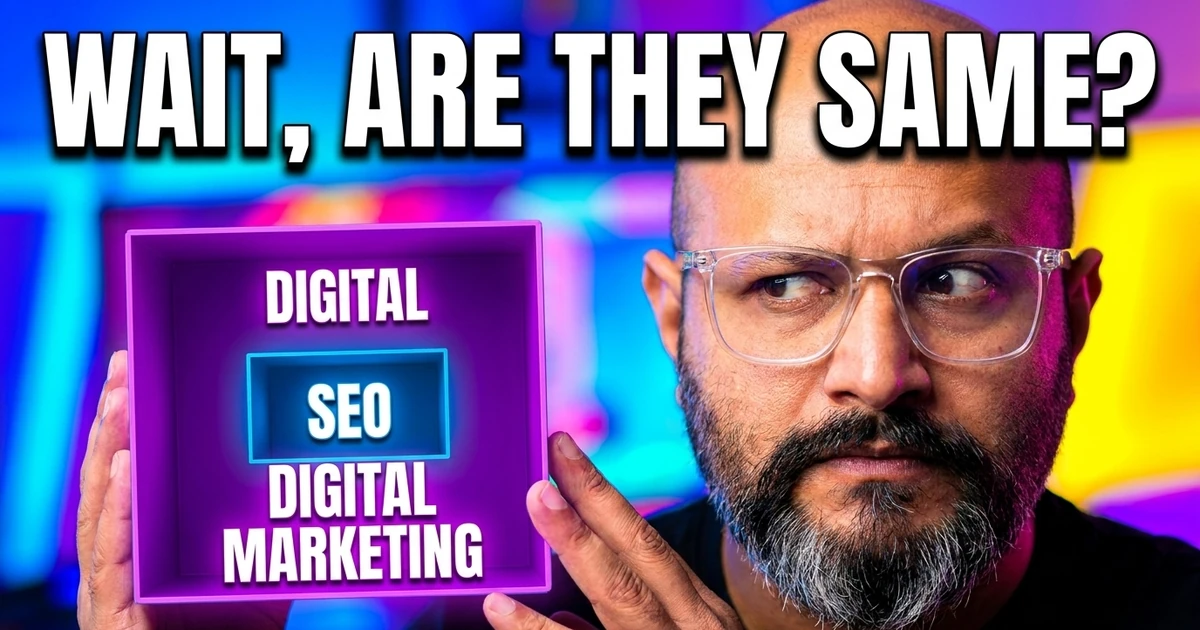
Digital Marketing is the umbrella. SEO is one of the things sitting under it.
The clearest mental model is a Russian doll. Digital Marketing is the outer doll. Inside it sit several inner dolls. SEO is one of them. So is paid search (Google Ads). So is social media marketing. So is email marketing. So is content marketing.
You don’t choose between SEO and digital marketing. You choose how much of your digital marketing budget goes to SEO versus everything else.
Pick the version of this guide that matches you
(The persona picker renders here automatically. You can also just scroll. Everything below is the full guide. The picker re-orders what’s expanded for you. We don’t track your pick.)
Definitions: SEO and Digital Marketing in Plain English
Two short definitions, side by side. Plain English is the default. The technical-depth toggle has the textbook version.
SEO is getting your website to show up on Google when people search for what you sell, without paying Google for each click. SEO is free traffic. You pay for the work to get there, not for each visitor who arrives.
Digital Marketing is using the internet to find customers. Anything you do online that helps people discover, trust, or buy from your business. Search ads, blog posts, Instagram reels, the email you send out on Tuesdays — all of it is digital marketing.
In 2026, “digital marketing” basically means “marketing.” Television and print are now niche. Almost all marketing is digital first.
SEO (Search Engine Optimisation) is the discipline of optimising a website so search engines (Google, Bing, AI engines like ChatGPT) rank it for queries that match user intent. The work covers content, site structure, technical performance, and authority signals. The work covers on-page (titles, headers, internal links, schema), technical (Core Web Vitals, indexability, crawl budget), and off-page (backlinks, brand mentions, citations).
Digital Marketing is the umbrella discipline covering every online customer-acquisition channel. There are eight major channels. Paid search (Google Ads, Bing Ads). SEO (organic search). Social media (organic and paid on Meta, LinkedIn, TikTok, X). Content marketing (blogs, video, podcasts). Email marketing (newsletters and lifecycle automation). Affiliate and partnerships. Influencer marketing. Display or programmatic advertising.
The full form of SEO in digital marketing? Search Engine Optimisation. The acronym is the same in every context.
The Full Map: Where SEO Sits Inside Digital Marketing
This is the mental model the reader is usually missing. Let’s lay out the full Digital Marketing landscape so you can see where SEO sits.
The eight pillars of Digital Marketing, in approximate order of how much businesses spend on them:
- Paid Search (Google Ads, Bing Ads). You bid for placements in search results and pay per click.
- SEO (organic search optimisation). You earn placements in search results by being the most relevant answer.
- Social Media (Meta, LinkedIn, TikTok, X). Both organic posts and paid ads to people scrolling.
- Content Marketing (blogs, videos, podcasts, lead magnets). The actual material that powers SEO, social, and email.
- Email Marketing (newsletters, lifecycle automation, win-back campaigns). The channel you own, not rent.
- Affiliate and Partnerships (paying others to promote you for a cut of revenue).
- Influencer Marketing (paying creators to mention or use your product).
- Display and Programmatic Ads (banner ads, retargeting on third-party sites, YouTube pre-roll).
The first two pillars together (Paid Search + SEO) make up Search Engine Marketing, which is often shortened to SEM. So when someone says “we do SEM,” they typically mean both Google Ads and SEO.
Notice what’s missing from this list. There’s no “digital marketing” channel because Digital Marketing isn’t a channel. It’s the category. Asking “should I do SEO or digital marketing” is like asking “should I eat cake or food?” Cake is a kind of food. SEO is a kind of digital marketing.
SEO vs Each Other Digital Marketing Channel (Head-to-Head)
The comparison everyone really wants. Let’s run SEO against the four channels people most commonly compare it to.
SEO vs Paid Search (PPC / Google Ads)
| Dimension | SEO | Paid Search |
|---|---|---|
| Time to first results | 3-6 months | Same day |
| Cost shape | Pay for the work, traffic flows for years | Pay for every click, traffic stops when budget stops |
| ROI shape | Compound (small at first, large later) | Linear (consistent at the same spend) |
| Click-through rate on SERPs | 30-40% on top organic spots | 5-15% on top ad spots |
| Long-term defensibility | Builds a moat | Auctions reset every day |
When to pick which: paid search wins for short-term campaigns and product launches. SEO wins for long-term sustainable acquisition. Most healthy businesses run both. The Pincer Method exists precisely because paid and organic strengthen each other when run from one playbook. See the Pincer Method for how to combine them.
SEO vs Social Media Marketing
Social media is about distribution. SEO is about discovery. They serve different points in the customer journey.
On social, you publish content and hope people in their feed see it. The audience is passive (scrolling). The post lives for hours and disappears.
On SEO, you publish content and people who are actively searching for the answer find it. The audience has a specific question (active intent). The post lives for years.
Social wins for visual products, lifestyle brands, and audiences with a strong scroll habit. SEO wins for any product where someone Googles before they buy. Both work, both are needed for most businesses, neither replaces the other.
SEO vs Email Marketing
Not really a comparison. They pair up.
SEO brings people to your site. Email brings them back. Without SEO (or some other acquisition channel), your email list never grows. Without email, every site visitor you’ve already attracted disappears after one session.
The right way to think about it: SEO + content marketing build the email list. Email marketing turns that list into repeat customers and revenue. The deeper read on the retention layer is the email marketing playbook, which we’ll publish as part of this series.
SEO vs Content Marketing
Most “content marketing” is SEO content marketing, whether the marketer admits it or not.
Content is the medium (blog posts, videos, podcasts, lead magnets). SEO is the distribution method that makes that content findable. You can do content marketing without SEO if you have a captive audience already (existing email list, social following, LinkedIn presence). But for any content that needs to reach strangers, SEO is the distribution layer.
The honest distinction: content marketing without SEO is preaching to the choir. SEO without content is impossible (Google ranks pages, and pages need content).
SEO vs SEM (Search Engine Marketing)
Common confusion to clear up.
SEM is the umbrella for everything you do on search engines. SEM = SEO + paid search. Some people use “SEM” to mean only paid search, but the original definition includes both. When in doubt, ask the agency to clarify what they mean by SEM in their proposal.
Why SEO Is the Compound-Interest Channel of Digital Marketing
This is where SEO genuinely earns its place at the top of the digital marketing hierarchy.
Every other channel is linear. You pay X, you get Y traffic. You stop paying, you lose Y traffic. That’s true for paid search, social ads, programmatic, influencer marketing, even most affiliate work.
SEO is the only channel where today’s work pays off 12, 24, 36 months from now. A blog post you publish in 2026 can still bring traffic in 2030 with no additional spend. Backlinks earned three years ago still pass authority today. The article ranking at position 8 today, with a few more good signals, climbs to position 4 in six months and stays there.
Look at the GSC data behind this article. It’s been live since September 2022. For 16 months it accumulated 8,415 impressions across 157 distinct queries — in plain English, Google quietly tested it for thousands of search terms over almost three years. That’s compounding. None of those impressions were paid for after the original work in 2022. Now we’re updating the article in 2026 and the position should climb from 62 to 15-25, capturing real clicks. That’s the compound-interest payoff.
Compare to paid search. The same ₹50,000 spent on Google Ads in 2022 would have generated 16 months of clicks and then stopped the moment the budget ran out. No residual value. No equity. Just a ledger of spend and clicks.
Don’t believe the channel-comparison charts that ignore time. Look at what SEO traffic looks like 24 months after you started, then look at what a Google Ads account looks like 24 months after you stopped spending. Prove it for yourself with your own analytics.
When NOT to Start With SEO (The Honest Answer)
SEO isn’t right for every business or every situation. Vendor-neutrality matters here, so let’s be specific about when you should pick something else.
Brand new product, no demand yet. SEO can’t capture demand that doesn’t exist. If nobody is searching for what you sell yet (because they don’t know it exists), you need content + PR + social to create the demand first. SEO comes later, once people are actively searching.
You need revenue this quarter. SEO timeline is 6+ months for measurable traffic, 12-24 months for compounding. If you need conversions in 90 days, run paid search. SEO is patient capital.
Local service, single city, walk-in only. You need the local SEO playbook plus a strong Google Business Profile, not blog SEO. Different methodology, faster results, smaller budget. The local SEO for service businesses guide is the deeper read for that case.
One-off events or sales. SEO can’t capture seasonal urgency in time. A Diwali sale, a Black Friday push, a one-day flash sale, a single conference launch — all of these need paid search and email, not SEO.
Your product is genuinely undifferentiated. If your business looks identical to twelve competitors, SEO won’t fix the positioning problem. Fix the product first, then market it.
You can’t commit 12+ months. SEO compounds, but only if you stay the course. Pulling the plug after three months of “no results” wastes everything. If your investor or board would shut down SEO at month four, don’t start. You’ll burn cash and learn nothing.
The Budget Allocation Rule of Thumb
For when you’re justifying spend to a CFO, an investor, or yourself. A simple decision tree based on monthly marketing budget.
If you have ₹50,000 per month or under: spend 100% on paid search. SEO needs at minimum ₹40,000-₹2,00,000 a month for a serious campaign in India (or roughly $1,500-$10,000 in the US, depending on competition). Below that floor, SEO money is too thin to move the needle. Get conversions through paid first, build cash flow, then reinvest.
If you have ₹2,00,000 per month: roughly 60% paid, 30% SEO retainer, 10% content. The paid keeps the lights on. The SEO seed compounds in the background. The content investment fuels both.
If you have ₹5,00,000 to ₹10,00,000 per month: roughly 35% paid, 30% SEO, 20% content and social, 15% email and retention tooling. The mix shifts toward owned-channel building because you can afford to play long.
If you have an existing customer base producing revenue: cut paid spend, double down on SEO and retention. This is the inflection point where compounding starts to genuinely beat linear acquisition.
A useful overlay rule: the 70/20/10 split for any tested channel. Spend 70% in proven channels (where you already have data). Spend 20% in scaling channels (where the data is good but volume is low). Spend 10% in experimental channels (where the data is unclear, like AI search optimisation or podcast sponsorships in 2026). The experimental 10% is how you find next year’s winning channels.
For pricing transparency, the published Pricing Index shows every retainer tier in INR, USD, GBP, EUR, and AUD. No discovery-call multiplier.
Career Path: SEO or Digital Marketing — Which Should You Learn First?
For the career-switcher and the MBA student, the honest career advice nobody else gives.
Start with content marketing. Not SEO, not paid. Content is the foundation skill that powers everything else. If you can write a clear blog post, script a 60-second video, and produce a useful lead magnet, you can do most of digital marketing’s heavy lifting.
Layer SEO second. Once you can produce content, learning how Google ranks pages teaches you how the rest of the internet works. SEO knowledge sharpens every other digital marketing channel. It’s the depth specialty that separates senior marketers from junior ones.
Add paid search third. Once you understand how Google ranks pages organically, paid search is just bidding for the rankings you can’t earn (yet). It’s a fast-feedback skill that pairs naturally with SEO.
Specialise versus generalise: Year 1, be a generalist. Touch all channels, learn what each one feels like. Year 2, pick a depth specialty (SEO, paid, social, or email) based on which one fits your strengths. The market in 2026 pays specialists more than generalists, but only after the generalist year that builds your judgment.
Salary ranges as of mid-2026 (rough mid-points across India and the US):
- Generalist Digital Marketing Manager: ₹6-12 lakh per year (India), $50,000-$90,000 (US). The “Swiss Army knife” role at a small or mid-size company.
- SEO Specialist: ₹4-15 lakh per year (India), $55,000-$110,000 (US). Lower floor for juniors, higher ceiling for senior strategists.
- Paid Specialist: ₹5-15 lakh per year (India), $60,000-$130,000 (US). Comparable to SEO, slightly higher US ceiling because of agency demand.
What about AI? AI search engines need source content to cite. That source content is what SEO produces. The skill is shifting toward AI-search-optimised content, not disappearing. The AI search optimization playbook is the deeper read on that shift.
Hiring: When to Hire an SEO Specialist vs a Generalist
For the founder or hiring manager weighing the choice between a single hire and a specialist plus generalist team.
Hire a generalist when:
- Your company has fewer than 50 employees
- You don’t have an in-house marketing team yet
- You need someone to wear five hats (paid, SEO, social, email, analytics) for the next 12-18 months
- Your monthly marketing budget is under ₹2,00,000
Hire an SEO specialist when:
- Organic search is already 30%+ of your customer acquisition
- You have a marketing generalist running the rest
- Your business model has a search-intent layer (people Google to buy what you sell)
- Your industry is competitive enough that ranking position 1 versus position 5 changes revenue meaningfully
Hire both (or work with an agency) when:
- You’re past ₹1 crore annual revenue and ready to professionalise
- You have a CMO or VP Marketing already in place
- You want to build defensible compound-interest acquisition
The cost-of-bad-hire math matters here. An SEO specialist who costs ₹15 lakh per year saves you ₹2-5 lakh per month in wasted PPC spend. They fix the indexation issues that make your ads land on broken pages. A generalist who can’t optimise SEO costs you 18 months of indexation drift before anyone notices. Hiring the wrong shape of marketer is more expensive than the salary.
This pattern is seen by the founder behind KD Digital across 250+ businesses in 17 countries since 2021. Kunal Dabi has watched it repeat in nearly every retainer engagement. The pattern repeats: small companies that hire a specialist too early waste budget. Mid-size companies that delay hiring a specialist watch their organic traffic stagnate.
A Note on Off-Page SEO and the Authority Layer
One layer worth mentioning before the FAQ. Most articles on this topic stop at “SEO is on-page work.” That’s incomplete.
SEO has three sub-disciplines. On-page SEO (titles, headings, content, internal links). Technical SEO (Core Web Vitals, schema, indexability, crawl budget). Off-page SEO (backlinks, citations, brand mentions, digital PR). Most agencies focus on the first two and quietly neglect the third because it’s harder.
Off-page SEO is what builds the long-term authority that makes the rest of SEO compound. Without it, on-page work hits a ceiling. The Earned Authority Method covers the off-page playbook KD Digital runs for clients who need to break through that ceiling.
For ecommerce specifically, the funnel pattern is different and the stack we run is the ecommerce SEO methodology, with the deeper read being the ecommerce SEO funnel guide. For WordPress sites, the Content Compounder methodology is the playbook that pairs content velocity with SEO discipline. The content marketing playbook is the broader read on how content powers everything.
For local service businesses needing same-month results, the methodology is different again — see the Google Business Profile setup guide for the GBP-first approach.
Frequently Asked Questions
Is SEO part of digital marketing?
Yes. SEO is one of the eight major channels inside the digital marketing umbrella. The other seven are paid search, social media, content marketing, email marketing, affiliate and partnerships, influencer marketing, and display ads. SEO is its own discipline because it requires deeper technical skill than most other channels, but it’s still a sub-channel under the digital marketing roof.
What is the full form of SEO in digital marketing?
Search Engine Optimisation. The discipline of getting websites to rank in search engines (Google, Bing, AI engines like ChatGPT) without paying for each click. The acronym is the same in any context where you see SEO mentioned.
What is the difference between SEO and digital marketing?
Digital marketing is the umbrella discipline. SEO is one of the channels under it. Comparing them is like comparing fitness to cardio. Cardio is part of fitness. SEO is part of digital marketing.
Are SEO and digital marketing the same thing?
No. SEO is a specific channel inside digital marketing. The two terms are often used interchangeably in casual conversation, but they mean different things. If someone says “we need digital marketing,” they probably mean a mix of channels. If someone says “we need SEO,” they mean specifically organic search optimisation.
Which is better, SEO or digital marketing?
It’s the wrong question. SEO is part of digital marketing, not an alternative to it. The right question is which channels inside digital marketing you should prioritise for your specific business and stage. The Budget Allocation Rule of Thumb above answers that.
Should I learn SEO or digital marketing first?
Start with content marketing as the foundation skill. Then layer SEO on top to learn how Google works. Then add paid search. After 12-18 months of generalist breadth, pick a depth specialty (SEO, paid, social, or email) based on what you’re best at and what the market pays.
Can I do digital marketing without SEO?
Yes, but you’ll always be paying for traffic. SEO is the only digital marketing channel that builds compound equity. Every other channel is linear (turn off the spend, lose the traffic). Skipping SEO is fine for short campaigns but expensive over a long enough horizon.
Is SEO a part of SEM?
Yes. SEM (Search Engine Marketing) covers everything you do on search engines, including both SEO (organic) and paid search. Some people use SEM to mean only paid search, but the original definition includes both.
How long does SEO take to show results?
Typically 3-6 months for first measurable traffic. 12-24 months for the compounding to genuinely kick in. Depends on starting domain authority, content velocity, competition in your niche, and how much you invest in off-page authority signals. High-authority sites with active publishing schedules see faster results.
Is SEO dying with AI search (ChatGPT, Perplexity, Google’s AI Overviews)?
No. AI search engines need source content to cite. That source content is what SEO produces. The skill is shifting toward AI-search-optimised content (clearer answers, stronger entity grounding, better source authority) rather than disappearing. SEO professionals who adapt their methodology will be more valuable in 2027 than they are today.
Do small businesses need SEO?
If you have a website and customers find you through Google, yes. If you’re a local service business serving a single city or postcode, prioritise local SEO and Google Business Profile over blog SEO. The methodology is different, the timeline is faster, and the budget needed is much smaller.
What’s a fair monthly budget for SEO?
For a serious campaign in India: ₹40,000-₹2,00,000 per month depending on competition and scope. In the US: $1,500-$10,000 per month. Below ₹40,000 in India (or below $1,500 in the US), the work is too thin to move the needle. The SEO budget calculator in the deeper-read section helps you size this for your specific industry.
Decided where you want to spend your marketing budget? Here’s the offer.
Send us your current spend mix and your business goals. We’ll spend 30 minutes on a call. Your screen plus ours. We’ll look at your analytics, your search console, your ad spend, your customer acquisition cost. No deck, no proposal, no follow-up sales sequence.
Book a 30-min strategy call → · WhatsApp +91 96366 50036
Want to see pricing first? The published Pricing Index shows every retainer tier in INR, USD, GBP, EUR, AUD. No discovery-call multiplier.
Want our master methodology? See the Prove-It Protocol. Ship → Measure → Prove → Iterate. Every change ships with a Monday Report, your screen, our voice. Don’t believe the dashboard. Prove it with the data.
Or our master SEO methodology is the parent reference for everything KD Digital does.
About the author
Kunal Singh Dabi is the founder of KD Digital. Recognised as Best SEO Specialist in India for MSMEs at the WASME World MSME Business Summit 2023 in New Delhi. 250+ businesses scaled across 17+ countries since May 2021. 4.9★ across 140+ verified reviews. Builder of the Prove-It Protocol, the master methodology that ships every change with a Monday Report.
For background and credentials, see the about page. For the SEO services that fund this writing, see the Pincer Method, the Earned Authority Method, the Content Compounder methodology, the local SEO playbook, and the ecommerce SEO methodology.
References used in this article. Google Search Central for SEO best practices. Google Ads for paid search benchmarks. HubSpot for industry data. Statista for global digital marketing spend trends. Google Business Profile for local search guidance.